Print ERP for packaging
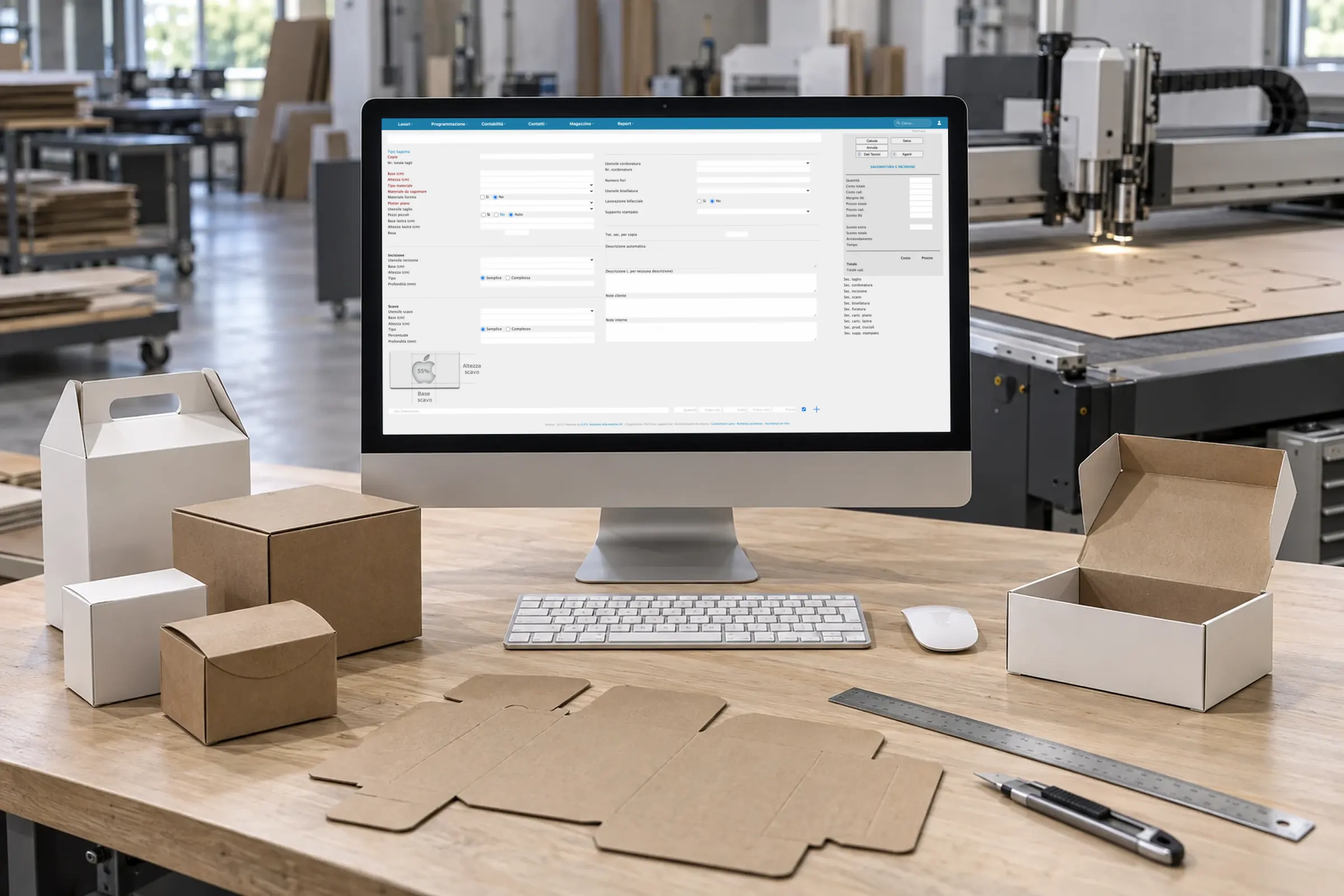
PrinTrace is the print ERP for those who print boxes, cartons and display units. Quotes across multiple print runs, die-cutting with the cutting dies kept in inventory, jobs with several operations, board stock, actuals and invoice.
What PrinTrace’s print ERP for packaging does, and doesn’t do
PrinTrace runs the office and department work, not the machine. It calculates the quote, opens the job, follows the tasks, deducts materials, issues the invoice. Die-cutting, shape-cutting and flatbed cutting are quoted as operations, and the cutting dies stay in inventory for reprinting. PrinTrace doesn’t drive the die-cutting machines and doesn’t do sheet imposition. It doesn’t manage a multi-level bill of materials. If your work is heavy in-line packaging production, let’s talk about it first. Better to know in half an hour than after signing.
Your work, three problems
Every box is a new quote
Format, board, weight, shape, print run. Ten minutes of doing sums by hand, when it goes well. Across 1,500 quotes a year that’s 250 hours. With the ERP the estimated time drops by 40%, around €2,500 a year. PrinTrace Mini Analysis 2025 on 30 companies, conventional hourly cost €25/h.
The customer asks for three print runs and you redo the sum three times
Five hundred, a thousand, five thousand. Three spreadsheets, three emails, three chances to get it wrong. With the comparative quote, the three print runs sit on a single document.
The job passes through three departments and nobody knows where it is
Printing, cutting, finishing, packing. Each step is a task inside the job. With status checking you know where the job is, without walking the departments.
The quote across multiple print runs
PrinTrace’s quoting tool calculates offset printing and small-format digital printing. The guided steps ask for one piece of data at a time: format, board, colours, quantity, finishing operations. The comparative quote puts 500, 1,000 and 5,000 pieces on a single document. The customer sees the unit price falling and decides faster. Does last year’s job come back? You duplicate the quote, change the board or quantity and send. The PDF comes out with your logo and goes out by email from the ERP. PrinTrace doesn’t choose between offset and digital for you: there’s no automatic comparison.
The quoting tool’s operations useful to packaging work:
- offset printing
- small-format digital printing
- die-cutting, with the cutting dies kept in inventory and reusable
- flatbed cutting plotter, for shapes, samples and cuts
- large format, for display units and signs
Die-cutting and shape-cutting
Die-cutting is an operation in the quoting tool, with its own times and costs. The flatbed cutting plotter is the operation for shapes and samples. It has its own times and materials. You configure it once, with name, material, measurements, times and costs. Then you choose it from the drop-down menu and the sum is automatic. The shape file stays attached to the job, so whoever cuts opens the right one. You log proofs and samples as tasks, with their own hours and materials.
Cutting dies sit in inventory as a reusable item. A customer’s cutting die is registered once, stays in stock and you call it up again at reprint without buying it back. In the quote for a repeat job, the cost of the die doesn’t come back, because the die already exists.
The job with several operations
The job is the customer’s order. The task is the single operation inside the job. A carton has printing, cutting and finishing: three tasks, one job. The job ticket is born from the quote, already filled in with format, material and delivery. The workflow assigns each task to the department and the operator. With status checking you follow progress without phoning production. Call-off orders cover the customer collecting the print run in instalments. Staff time sheets record the real hours on each task.
Board stock in inventory, by format and weight
Every board is its own material. You register it once, as you buy it, with the format and weight in the name you use in-house. To each material you link the supplier items, that is, the same board as each supplier sells it. You put what you need in the cart, PrinTrace creates the order and you send it from the ERP. On delivery you log the goods and the quantity enters inventory. Every task deducts what it consumes and you log the waste. For each material you set a minimum stock and the low stock alert arrives. Purchase and consumption statistics tell you how much you buy and how much you really use.
Cutting dies follow the same path as materials, but they’re not consumed: they stay in stock and become available again for reprinting the same carton.
Actuals and invoice
At the end of the job you compare quoted to actual, job by job. Hours from the time sheets, materials consumed, waste: the margin is the real one. The delivery note travels with the goods and picks up the job data. The e-invoice is generated from the same data and goes out to the SDI with no intermediaries. The payment schedule tells you who owes what and when, reminders go out single or in batch. The dashboard indicators follow turnover, material consumption, purchases and productivity, with the alert thresholds you set.
Case type B, company with 8-15 employees. 1,500 quotes, 2,760 tasks and 960 invoices a year. The estimated recovery is 263 hours, around €6,575. Including “where’s my job?” requests, the total reaches €12,617 a year. PrinTrace Mini Analysis 2025 on 30 companies, conventional hourly cost €25/h. Average figures, not a promise. See the three case types →
One set of data, from quote to invoice
The box quote becomes a job without rewriting anything. Tasks deduct board from inventory and log the waste. On delivery, the delivery note and e-invoice go out with the same data. Regular customers’ reorders come in through the customer portal, with the file attached. Consumption, purchases and productivity end up in the dashboard indicators.
Frequently asked questions about packaging
Are cutting dies managed in inventory?
Yes. Each cutting die is a reusable inventory item. You register it once, it stays in stock and you call it up when the customer reprints the same carton. You don’t buy it again and don’t put it back in the quote. In inventory you see which dies you have and for which customer.
Does PrinTrace manage packaging?
It manages the work around packaging. Quotes across multiple print runs and shape-cutting on the flatbed cutting plotter. Jobs with several tasks, board stock in inventory, actuals and invoice. Industrial die-cutting and sheet imposition stay outside the ERP. Bring us one of your typical boxes and we’ll check it together, operation by operation.
Can I quote the same box across three print runs?
Yes, with the comparative quote. Put 500, 1,000 and 5,000 pieces on the same document and the customer sees the price for each quantity. The PDF comes out with your logo and you send it by email from the ERP. If the customer accepts, the chosen quote becomes a job.
How do I keep board stock in inventory?
You register each board as a material, with the format and weight in the name you use in-house. You link the supplier items and order from the cart. On delivery the quantity enters inventory, tasks deduct it and you mark waste. The low stock alert tells you when to reorder.
How much does PrinTrace cost for a carton company of eight people?
The monthly fee starts from €59 per user per month, excluding VAT, with support included. Onboarding starts from €2,540 as a one-off and covers the initial setup and loading your records. The contract runs for a minimum of one month, with no notice period.
Want to know if PrinTrace covers your packaging?
Bring us a real job, ideally a shaped box requested across several quantities. In 45 minutes, online or in person, we’ll redo it together in PrinTrace. If something’s left out, we’ll tell you there.
Tel. +39 06 5290689 · info@printrace.eu
DPS Soluzioni Informatiche, Viale Giorgio Ribotta 11, 00144 Rome, Italy